The 6 Steps into the Startup World
From Shark Tank to Picking One Battle

Hi everyone and welcome to this week's edition of Cheatcode.
Today I am covering two topics around first steps in the startup world. First I will walk you through the different phases that many students go through on their journey into startups.
Then I will rank the most common internships by how useful they actually are whether you want to build a startup or join one.
Authors Note
The 6 Steps into the Startup World
This is a summary of the steps that I have seen other people go through and that I also partially went through myself when getting into the startup world.
1. Knowing the Cliches
At this stage, I just knew the term "startup", but the only thing I associated it with were shows like "Höhle der Löwen" (the German equivalent of Shark Tank). While of course these shows have a strong emphasis on entertainment over education, sometimes featuring outrageous products like flavored toothpicks, it was all I knew.
2. Understanding the Concept
In this stage, mostly through my business adminstration studys, I started to understand the general concept of what startups actually are. I learned that these are the modern way of building companies, often involving raising large amounts of money and operating in areas like e-scooters, food delivery or enterprise software. But the whole topic still felt far away. Like something other people are doing.
3. First Attempts
But then I started noticing startups everywhere. I joined the local entrepreneurs club, devoured podcasts and articles, and tried a few things on the side. Started a niche Instagram page, stopped posting after a few months, and registered a business for flipping used products without ever really getting started. The real first taste of the startup world came through my first startup internship.
4. Real Action
For me, this came through a university course and a startup summer school I joined for two days. From around 50 people in the previous course, I was the only one to show up. For the first time, I was in a room with people who also wanted to start something themselves.
On the first day I talked to 20 other people, some with ideas, some without. Everyone was at the very beginning but motivated and open. So I just picked one team and suddenly I was part of it: choosing a name, mapping the user group, discussing features, deciding who builds the website.
A few months later I joined another team that was a bit further along. That led to launching a website and product, completing a startup program, winning a pitch competition with €2.5k in prize money, splitting the equity, making the first €1,000 in revenue, losing a co-founder, switching from B2C to B2B, and making another €2,500.
5. The Trap (too many ideas and projects)
At some point the problem flips. Instead of having no ideas, you suddenly have too many. I started writing them down in a spreadsheet, which now has over 100 rows, and kept trying different things on the side.
The old problem of not knowing what to do disappears. The new problem is not getting anywhere, because you can't do 100 things at once. And the one idea you are working on gets diluted by the time and energy you put into university, your job, and everything else.
For anyone wondering, this is also still my current stage.
6. The Decision
I think this is where things get real. Up to this point, the journey is mostly fun and low risk, and I genuinely think everyone should go at least this far. Launch something, build a product, win a small pitch competition, make your first €1,000 in revenue. The cost is relatively low, maybe 10 to 20 hours a week alongside university, but the experience is huge.
And honestly, I think it is totally fine and worth it to only go this far. Working at a startup rather than founding one is a totally valid path, and the experience you built up to this point makes you a much stronger candidate for exactly that.
But the other option, which probably only some people should take, is picking one idea and committing to it for the next 5+ years without a backup. This is where the separation between a student startup project and an actual startup happens.
People make this decision at very different stages of life. Some drop out of university, some wait until after their master's, some after a few years in consulting, at 30, 40, or 50. There is no right time. But if this journey leads you to the point where you want to take that leap, with the chance of building something bigger than yourself, then at some point you have to leave the "many ideas" stage behind and pick one battle.
Internships Ranked
This is my take on how useful different internships are for working at a startup long-term, or for launching your own startup project. All of these are common internship options in the business landscape, and none of them are inherently wrong. I just think some offer more relevant learning for the startup world than others.
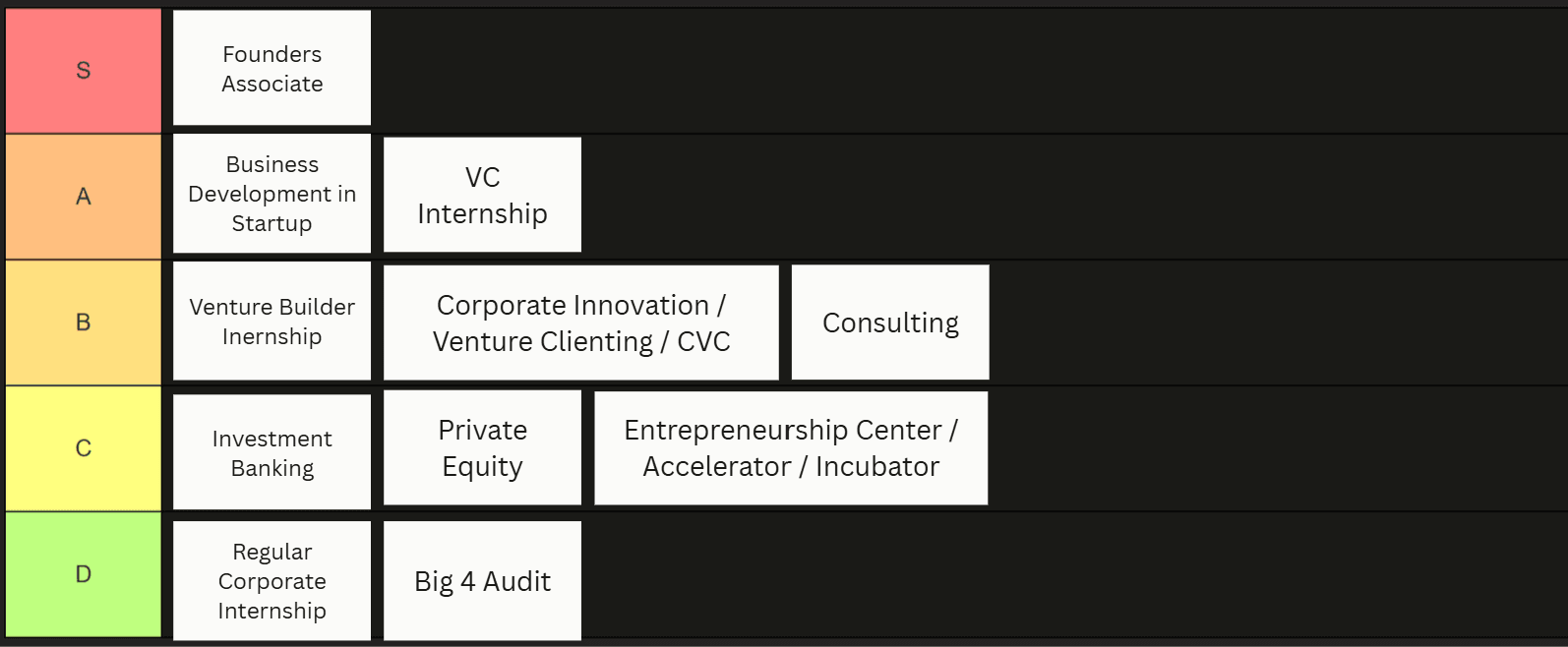
Let's start at the bottom. Internships in Marketing, Tech, Business Development, or Recruiting at a Corporate are probably the furthest from the startup skillset. You might pick up some hard skills, but the scale corporates operate at is too far from the hands-on, scrappy approach startups require. Marketing at a corporate is simply not the same as marketing at a startup.
The same goes for Big 4 Audit internships. Very common for business students, but unless you want to go into finance or accounting, most people don't get that much out of it.
Private Equity and Investment Banking are similar. Very specific finance skills that don't always transfer. What does transfer is the work ethic and structured, detail-oriented approach. In PE you also get a solid understanding of how businesses operate as a whole.
VC internships are great because you see a lot of different startups and quickly start recognizing patterns in what business models, markets, and founders are truly exceptional.
Business Development or GTM internships at an early-stage startup are another strong one. You get great exposure to the commercial side, often at the intersection of product and sales. Talking to potential customers and understanding what is truly valuable to them is one of the most important things happening at an early stage startup.
The final evolution of this is the Founder Associate internship, where you are the right hand of one of the founders. Similar to Business Development, you get commercial exposure, but beyond that also exposure to the strategic topics founders deal with daily, including hiring and fundraising. Definitely my top recommendation for everyone who wants to see how a startup is built and run from start to finish.