Why most student startups pivot
From B2C to B2B and what drives the shift
Hi everyone and welcome to this week’s edition of Cheatcode. Today I will share a common pivot that many early stage student startup projects go through and also share the very post that got me to start this newsletter
Also, since nobody claimed the free book last time, I want to reiterate that I will send a physical copy of Deep Work to the first person who sends me a quick email at cheat-code@web.de.
Authors Note
Were most student startups start
There is a very common pivot in first startup projects that I have seen over and over again and experienced myself.
Many early stage startups, especially student projects, start as B2C. They target consumers. But over time, they realize how hard it is to get people to pay and that there might be another customer group where their offering is a better fit.
Business to Consumer is tought
Consumers are used to free products. When they do spend money, it is usually on well known brands. At the same time, they are flooded with marketing every day and ignore most of it.
Yes, it is still possible to win in B2C. Either through distribution, such as supermarkets or App Store listings, or by mastering channels like social media, ads, influencer marketing, or SEO. But it is a tough game and not as easy as most people think.
The shift in customer group
That is why many of these projects shift to B2B. Selling to businesses comes with a clearer value proposition. If you help a company make more money or save costs, they listen. And once you get them as a customer, they also pay more than a consumer would. What is €5 for a consumer can be €500 for a business. What is €500 can be €50k. With just a few customers, you can build a solid base.
The reason most student founders do not start there is simple. They have only ever been consumers. They do not yet understand how businesses think, buy and decide. That typically changes with more work experience and seniority. However, getting started here can be as simple as messaging 100 people on LinkedIn and having a few 30 minute calls with those who respond.
The Post that got me to start writing
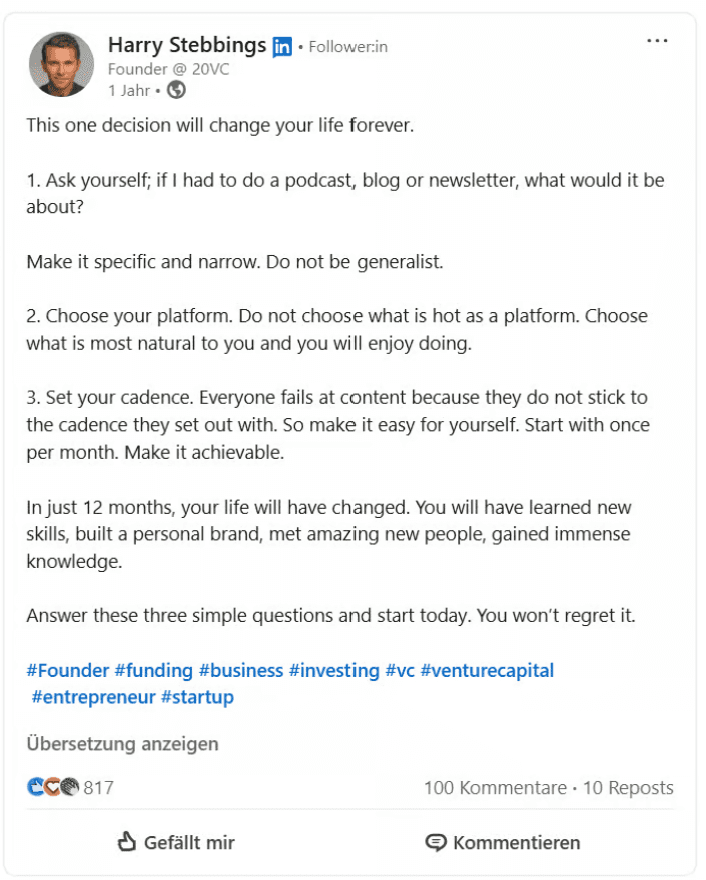
This is the post that got me to start this newsletter. Since it has been almost a year, I wanted to write a quick reflection.
Overall, I am very happy that I started sharing my thoughts here and also quite satisfied with where the newsletter stands today. Rereading the original post, I realized that I did not follow every instruction as intended and might have to sharpen up here and there.
I tried to narrow the focus as much as possible, but I do not feel like I have fully figured that out yet. Right now, the main topic is taking the first steps into the entrepreneurial world, but that is still quite broad. Let’s see if I find a better angle, or we might even find the right fit here together.
With the platform choice, I am very happy. Newsletters might not be the hottest thing right now, but it felt natural to me and still does. It feels much better than being just another person on social media trying to go viral.
The sentence in the above post about how everyone fails at content because they do not stick to the cadence they set out with stings a lot, as that has probably been the main thing slowing my growth in the second half of the year. I will do better, let’s see in next year’s reflection ;)
Value Drop
1x copy of one of my recent favorite book: Deep Work by Cal Newport
I am not entirely sure what went wrong here last week. Either nobody wanted the book, which would be a shame because it covers an important topic and is a great read. Or nobody thought I would actually follow through and send it. That’s why I will say it again.
If you are the first to claim the book by writing to me at cheat-code@web.de.
I will send you a physical copy worth around €10 to €20.